Quick verdict: The Peak Design Outdoor Backpack 45L ($329.95) hits the exact sweet spot for multi-night camping — big enough to swallow a full weekend of gear, structured enough to carry it comfortably, and weatherproof enough that you stop worrying about the sky. Its 3-part spring-steel frame gives it real load support, the roll-top expands when you overpack (you will), and the modular interior means it moonlights as a camera bag without missing a beat. It isn’t an ultralight thru-hiking pack and it isn’t cheap, but for weekend trips where you’re hauling everything, the 45L is the size to get.
The hardest part of packing for a multi-night trip isn’t the gear. It’s the bag. Too small and you’re strapping things to the outside and playing Tetris at the trailhead. Too big and you overpack because you can, then carry the penalty on your back. The 45L Outdoor Backpack lands right in the middle, and after a season of weekend trips, it’s become my default.
What is the Peak Design Outdoor Backpack 45L?
Peak Design built its name on camera bags, then made a genuine outdoor pack — one designed to haul camping gear and camera kit with equal ease. The 45L is the largest of the line. The essentials:
| Spec | Detail |
|---|---|
| Price | $329.95 |
| Capacity | 45L (expandable roll-top) |
| Frame | 3-part spring-steel internal frame |
| Shell | Terra Shell 210D ripstop nylon — weatherproof, abrasion-resistant |
| Sustainability | 100% recycled, bluesign-approved, PFAS-free |
| Closure | Expandable roll-top with Ultra Cinch |
| Hydration/laptop | Sleeve fits a 3L bladder (hose pass-through) or a 16″ laptop |
| Suspension | Vest-style load-lifter straps, hip belt, ventilated back panel |
| Weight | ~1.55 kg claimed (real-world closer to 1.9 kg) |
| Sizes / colors | 18L, 25L, 45L / Black, Eclipse, Cloud, Kelp |
| Warranty | Peak Design lifetime guarantee |
The through-line is versatility: it’s a hiking pack that transitions to a travel bag that transitions to a camera hauler, and it’s built around Peak Design’s modular Camera Cubes and Packing Cubes if you want to organize the interior your way.
The 45L size is the whole point for camping
This is what you came to the review for, so let me be specific.
For a two-to-three-night trip, 45 liters is the number. It comfortably held my sleep system, a layered clothing kit, a food bag, cook setup, and the usual pile of small essentials, with room left rather than a fight to close it. That “room left” matters more than raw capacity — it’s the difference between packing thoughtfully and cramming.
And when you do overpack — everyone does on the first night out — the expandable roll-top is the release valve. Cinch it down over a light load for a compact, stable carry, or roll it up and over to reclaim real volume when you’re hauling extra food or a bulky layer. One bag flexes across a surprisingly wide range of trip lengths, which is exactly what you want if you’re not buying a different pack for every weekend.
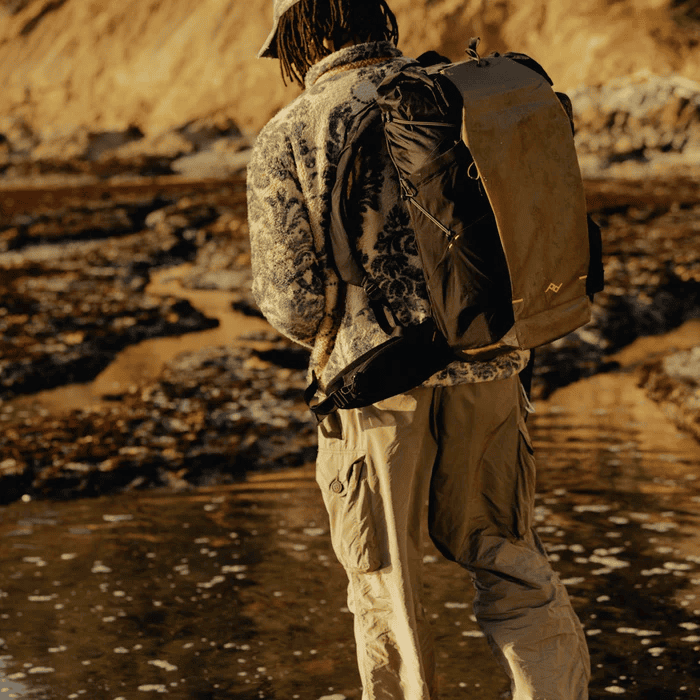
The 3-part spring-steel frame is the unsung hero here. A lot of do-everything bags go frameless to save weight and turn into a sad sack the moment you load them. This one holds its shape and transfers weight to your hips through a proper hip belt, so a full multi-night load rides like it’s supposed to instead of dragging on your shoulders. On the trail that’s the whole game.
Hauling all the gear
A few features earn their keep once the pack is loaded:
Access. Multiple entry points mean you’re not excavating from the top every time you need something. The item you need at the bottom is reachable without unpacking the whole bag — a small thing that becomes a big thing at a windy trailhead.
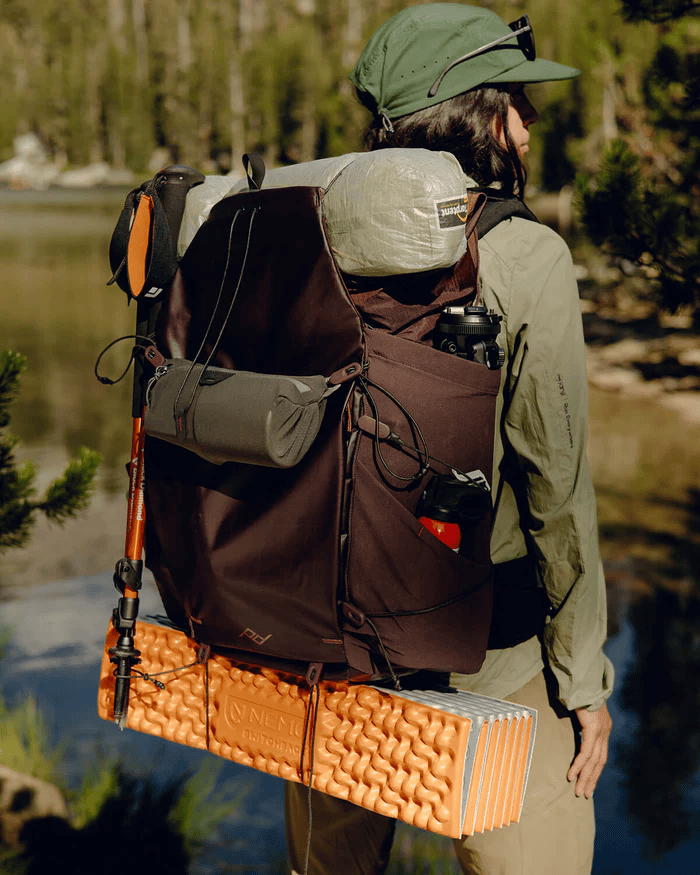
External storage. Vest-style load-lifter straps include quick-access pockets, and there’s a versatile external attachment system for the stuff that lives outside the bag — trekking poles, a wet layer, a tripod. Expandable exterior storage picks up the overflow.
Hydration. The dedicated sleeve takes a 3L bladder with a hose pass-through up top, so you can drink on the move without stopping. Off the trail, that same sleeve swallows a 16″ laptop — the trail-to-travel trick that makes this a one-bag option for a trip that starts at a desk and ends at a campsite.
Weatherproof, and it matters
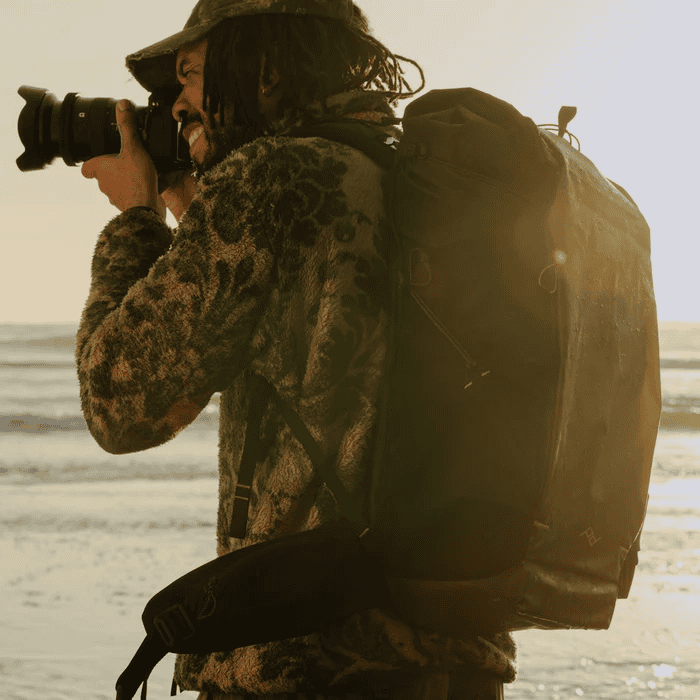
The Terra Shell 210D ripstop nylon is weatherproof and abrasion-resistant, and on a trip where an afternoon storm rolls through — which, in the mountains, is most of them — that translates to not thinking about your gear. Rain shell on, keep walking. It’s also bluesign-approved, PFAS-free, and 100% recycled, which is the kind of materials story I like to see and increasingly expect at this price. Peak Design’s lifetime warranty backs the whole thing, which softens the sticker.
The camera-bag crossover
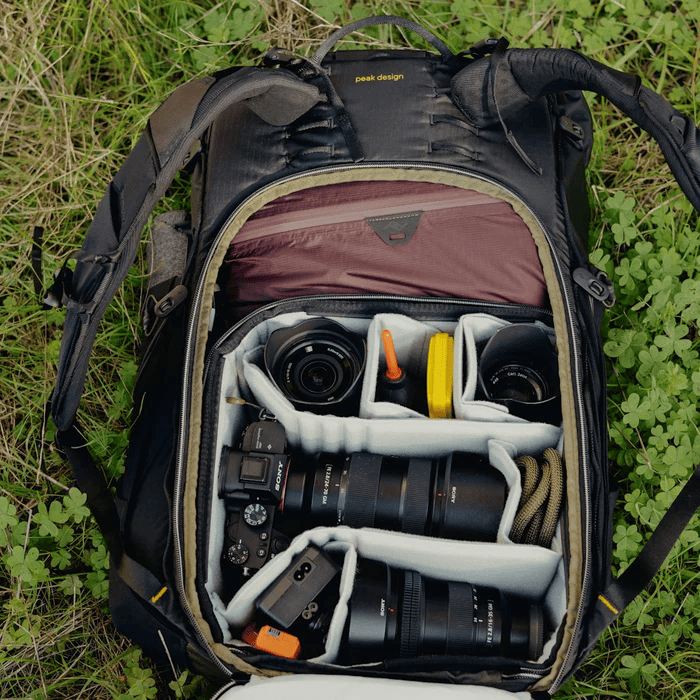
Worth a paragraph because it’s genuinely part of the value: this pack is built to accept Peak Design’s Camera Cubes, so if you shoot on your trips — I do — you can drop in a padded cube and turn the main compartment into protected camera storage, then pull it out and go back to a pure gear hauler. For anyone carrying a camera into the backcountry, that modularity is a real reason to choose this over a dedicated hiking pack that treats your camera as an afterthought.
Honest notes
It’s not an ultralight backpacking pack. At roughly 1.9 kg real-world, it’s light for what it is — a framed, weatherproof, do-everything bag — but a dedicated thru-hiking pack will weigh less. If you’re counting grams for long-distance trail miles, this isn’t that tool. For weekend and multi-night camping where durability and comfort matter more than shaving ounces, it’s dialed.
The roll-top has a learning curve. The Ultra Cinch and compression-cord system is clever but takes a few trips to get smooth. Early on it slows down access; once it’s muscle memory, it’s fine.
The price. $329.95 is premium. You’re paying for the frame, the materials, the modular ecosystem, and the lifetime warranty. If you’ll use the versatility — camp, travel, camera — it earns it. If you only ever need a simple weekend pack, there are cheaper ways to get 45 liters.
Who it’s for
- Buy it if: you want one pack for multi-night camping that also handles travel and camera carry, you value load support and weatherproofing, and you’ll use the modular system.
- Skip it if: you need the lightest possible pack for long-distance backpacking, or you want a budget option.
Peak Design Outdoor Backpack 45L: the verdict
The best pack is the one that makes packing a non-event and carrying a non-thought. For multi-night camping, the Outdoor Backpack 45L does both — the size is right, the frame carries a full load properly, the roll-top flexes when you overpack, and the weatherproof shell means you stop watching the sky. Add the camera-cube modularity and the lifetime warranty and the $329.95 starts to make sense as one bag doing the work of three.
It’s the pack I now grab for a weekend in the mountains without thinking about it. That’s the highest compliment I give a piece of gear.
FAQ
Is the Peak Design Outdoor Backpack 45L good for multi-night camping?
Yes. 45 liters comfortably holds a sleep system, clothing, food, and cook kit for a two-to-three-night trip, and the expandable roll-top adds capacity when you overpack. The internal frame and hip belt make a full load carry comfortably.
How much does it weigh?
Peak Design lists it around 1.55 kg; independent testing puts the real-world weight closer to 1.9 kg without accessories. It’s light for a framed, weatherproof pack but heavier than a dedicated ultralight backpacking bag.
Is it waterproof?
It’s made from weatherproof, abrasion-resistant Terra Shell 210D ripstop nylon that protects your gear in wet conditions. It’s highly weather-resistant rather than fully submersible-waterproof.
Can it carry camera gear?
Yes. It’s designed around Peak Design’s modular Camera Cubes, so you can convert the main compartment into padded, protected camera storage and remove it when you don’t need it.
Does it fit a hydration bladder?
Yes — the dedicated sleeve holds up to a 3L bladder with a hose pass-through at the top, and the same sleeve fits a 16″ laptop for travel.
What size should I buy?
For multi-night camping, the 45L is the pick. The 25L suits day hikes and overnights, and the 18L is a compact daypack. All come in Black, Eclipse, Cloud, and Kelp.
How much does it cost?
$329.95, backed by Peak Design’s lifetime warranty.