
Open-ear headphones solve a real problem. When you run roads at dawn or ride with traffic, sealing your ears off with buds is a genuine safety risk. You want your music and the sound of the truck coming up behind you. That’s the whole pitch for bone-conduction sets like the Suunto Wing 2—stay motivated, stay aware.
On paper, the Wing 2 is loaded. In practice, I kept running into the one thing a pair of headphones can’t afford to get wrong: the sound.
I wanted to like these. Here’s what I actually found.
What Suunto Promises
Credit where it’s due—the Wing 2’s feature list is impressive, and most of it delivers.
- Build and weather resistance: a 35g titanium frame with an IP66 rating that shrugs off sweat, rain, and dust. It feels genuinely rugged.
- Battery: up to 12 hours on the headphones, plus a bundled powerbank case that pushes total playtime to around 36 hours, with a 5-minute fast charge for topping off.
- Safety LEDs: motion-reactive lights that pulse with your cadence and flash when you check for traffic—a smart, thoughtful touch for low-light miles.
- Wind-resistant mic: dual microphones tuned to cut wind noise for calls up to 30 km/h.
- App and watch integration: EQ tuning in the Suunto app, plus text-to-speech metrics piped in from a Suunto watch.
This is a well-engineered piece of hardware. The problem isn’t the spec sheet. It’s what happens when you press play.
The Problem You Can Hear
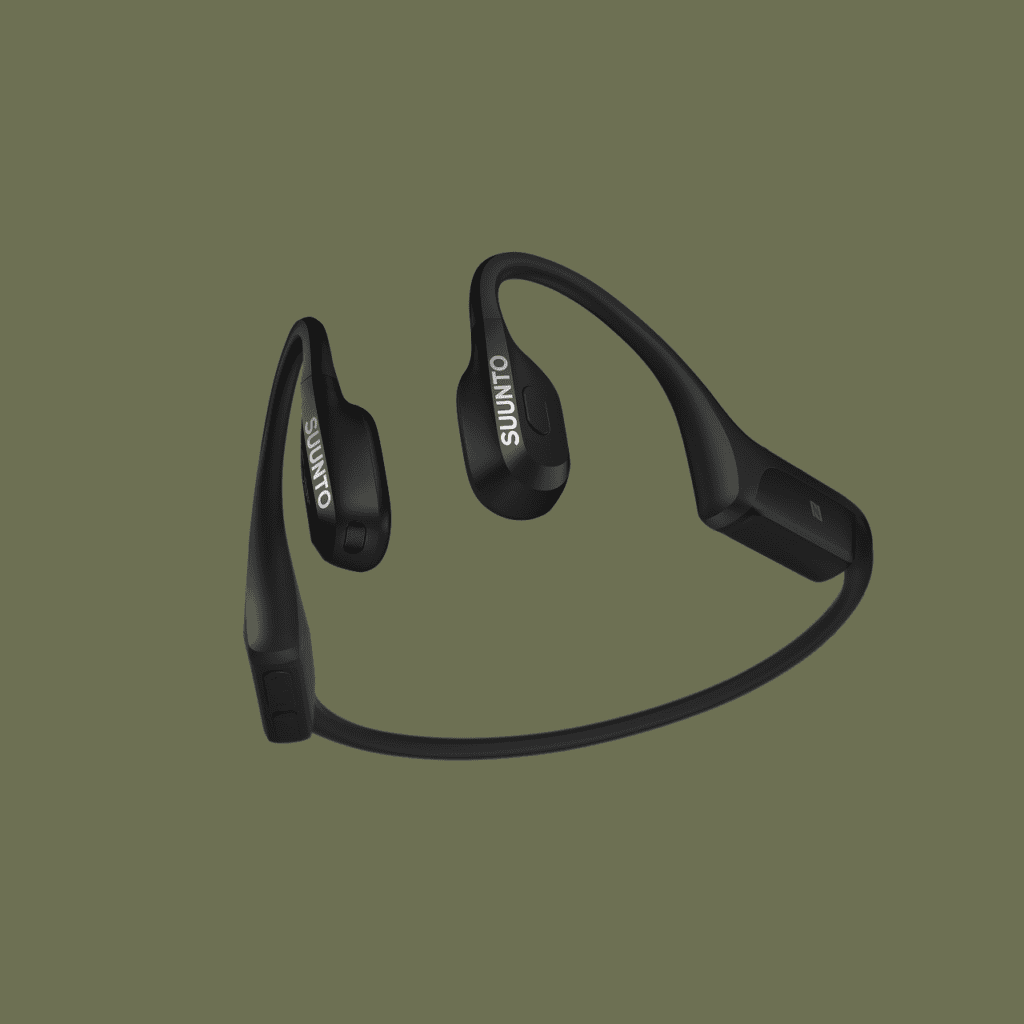
In their natural resting position, the Wing 2 sounds tinny. Thin, hollow, and quiet enough that I found myself cranking the volume to maximum just to follow along—and even then, the audio never filled out.
Then I stumbled onto the fix, and it tells the whole story. When I pulled my hair back and let the headphones rest on my ponytail, then tilted them toward my ears, the sound noticeably improved. More body, more clarity, less strain to hear.
That’s diagnostic. Bone-conduction audio lives and dies on contact and placement—the transducers have to sit right against the cheekbones to transfer sound efficiently. In their default position on my head, they simply weren’t seating well, and the audio suffered for it. Nudge them into better contact and the sound comes up.
Two honest takeaways from that. First: the sound quality is fixable, but only by fussing with placement, which is not something you want to be doing mid-run. Second—and in fairness to Suunto—fit like this is partly a function of head shape and hairstyle, so your experience may land differently than mine. But a pair of headphones that only sounds good when you fight them into position is asking a lot.

Head to Head: Suunto Wing 2 vs. Shokz OpenRun Pro 2
The clearest way to judge a pair of headphones is against a known quantity. I put the Wing 2 up against the Shokz OpenRun Pro 2, which we’ve already reviewed and liked.
It wasn’t close. The Shokz sounded noticeably crisper and fuller straight out of the box—no placement gymnastics required. That gap held across both music and spoken word. On podcasts and audiobooks, where clarity of the human voice is everything, the Wing 2’s thinner profile made voices harder to track, while the Shokz stayed clean and present. For music, the Shokz simply had more there there.
If sound quality is your top priority in this category, the comparison is hard to argue with.
How They Held Up, Use Case by Use Case
Open-ear headphones get tested by the noise around you, so I ran them through four very different environments.
- Running outdoors: This is the best-case scenario, and where the Wing 2 is most usable. In quiet air, at a decent volume, the sound is acceptable and the situational awareness is excellent—you hear everything around you, which is the entire point.
- Treadmill: The rhythmic pounding of a treadmill competes directly with open-ear audio, and here the Wing 2’s thin sound got swallowed. I was back to max volume and still straining.
- Cycling: Wind noise is the enemy of open-ear sound, and riding at speed, the audio struggled to stay above it. The wind-cutting mic is for calls, not playback, so the music took the hit.
- Rogue Echo Bike: An air bike’s fan is a wall of white noise, and it flatly overpowered the Wing 2. Indoor efforts on the Echo were the toughest test, and the headphones lost.
The pattern is consistent: the louder the environment, the more the Wing 2’s underpowered sound gets exposed. Open-ear designs always give up some ground to ambient noise—that’s the tradeoff for awareness—but the Wing 2 gives up more than it should.
What They Get Right

This isn’t a total write-off. The build quality is excellent, the IP66 durability is real, the battery-plus-powerbank setup is among the best in the category, and the safety LEDs are a legitimately good idea for anyone logging dark-morning miles. If your priorities are ruggedness, runtime, and visibility over pure audio fidelity, there’s a real case here.
But most people buying headphones are buying them, first and foremost, to listen.
The Verdict
The Suunto Wing 2 is a well-built, feature-rich pair of open-ear headphones let down by the thing that matters most. In their natural position they sound tinny and demand full volume, and only careful placement brings the audio up to par. Head to head, the Shokz OpenRun Pro 2 outperformed them on both music and spoken word without any fuss.
If you want the rugged build, the long battery life, and the motion-reactive safety lights, and you’re willing to dial in the fit, the Wing 2 has genuine strengths. But if crisp, effortless sound is what you’re after—especially in noisy environments like a treadmill, a windy ride, or next to a roaring air bike—there are better options in this category. For most runners and riders, I’d point them to the Shokz first.
Technical Specs at a Glance
Suunto Wing 2
- Type: Open-ear bone-conduction headphones
- Weight: 35g titanium build
- Water/dust resistance: IP66
- Battery: Up to 12 hours; ~36 hours total with included powerbank; 5-minute fast charge
- Operating range: -20 to 60°C
- Mic: Dual microphone with wind-noise reduction up to 30 km/h
- Safety: Motion-reactive LED lights (running & cycling modes)
- App: Suunto app EQ tuning; text-to-speech metrics with a paired Suunto watch